In Italy almost all tables are set with a bowl of Parmigiano Reggiano to sprinkle or a block to grate over the food. It is a fine cheese, loved all over the world. I became curious and wanted to know when Parmigiano Reggiano was born and why it is so prized.
Parmigiano Reggiano was born in the Middle Ages, around 1100–1200, in the Benedictine and Cistercian monasteries of the Emilia Romagna region. These hardworking monks needed a cheese that would last, one suitable for long periods of storage, so they developed a technique involving raw cow’s milk, large copper cauldrons, slow cooking, and long aging.
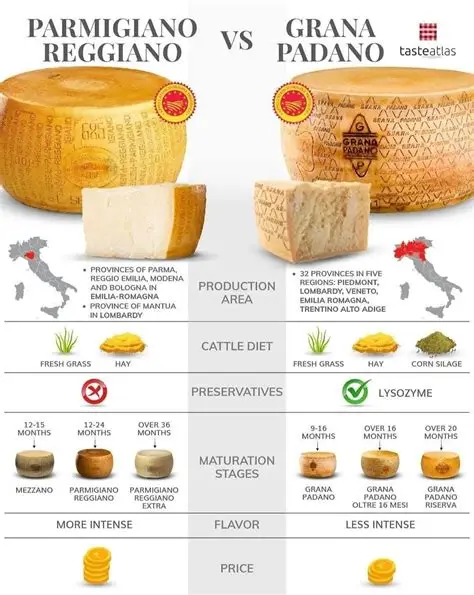
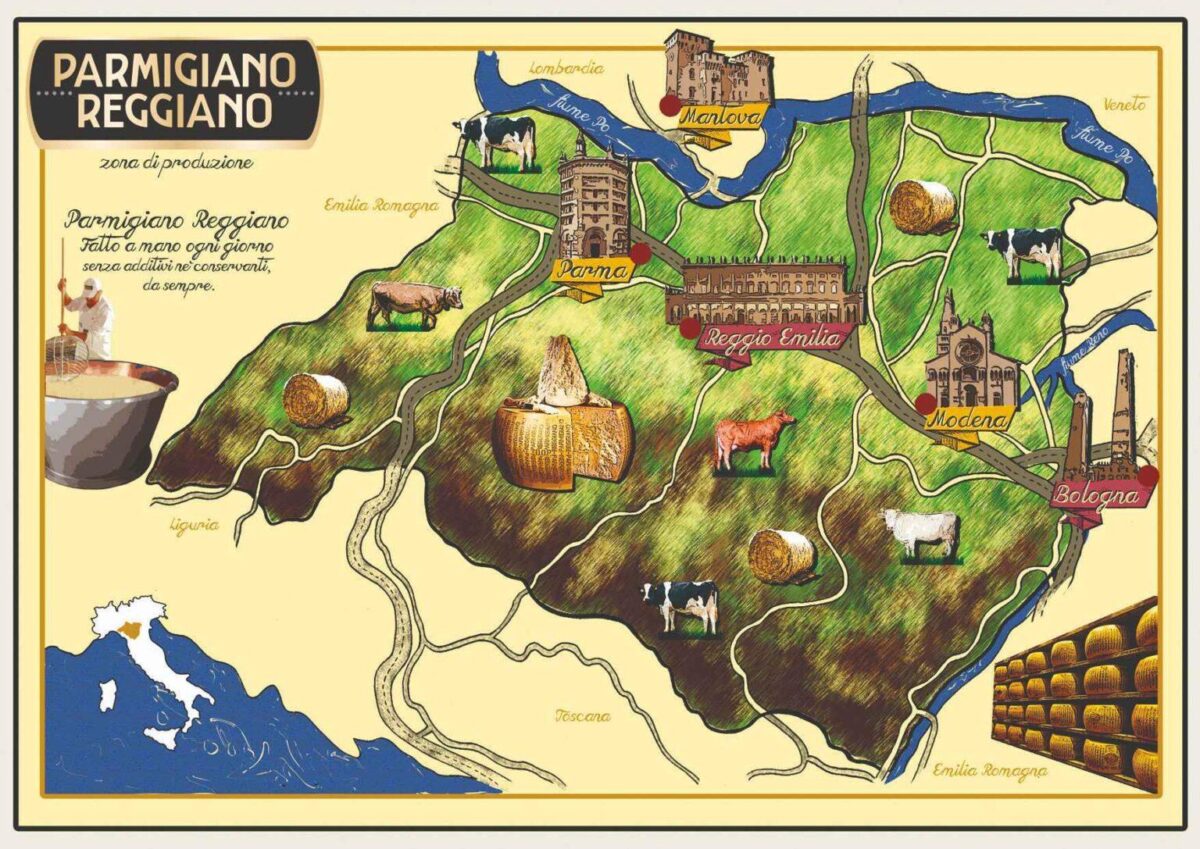
Parmigiano Reggiano can’t be produced outside of its home area of Parma, Reggio Emilia, Modena, Bologna, and Mantua (south of the Po). This is the perfect territory because of the grass on which the cows feed, the Emilian river water, its ideal climate for aging, and the salt from the salt pans of Salsomaggiore.
Parmigiano would not exist without the salt of Salsomaggiore, one of the oldest salt pans in Italy. Salt was so precious in the Middle Ages that it was protected like treasure. Without that salt, the brine would not have worked and the cheese could not have aged.
The combination of these unique elements created a cheese impossible to replicate elsewhere. (The French tried, but they failed!) According to the legal specification, Protected Designation of Origin, it can only be produced in this one designated area. Just as a sparkling wine can be called “Champagne” only if it comes from the Champagne region of France, a cheese cannot be called “Parmigiano Reggiano” unless it originates in the defined area of Italy.
The history of Parmigiano spans the centuries. By the 1300s Parmigiano was so famous that Dante Alighieri mentions it in the Divine Comedy. He speaks of an area “where Parmigiano cheese is made.” It was already a “branded” product. But its story continues…
In the Middle Ages, Parmigiano was so precious that it was used as a currency. Documents tell us that some parishes received wheels of Parmigiano as payment for masonry work or for the construction of chapels. One wheel was worth as much as a month of work.
In the Renaissance it was a luxury enjoyed by the aristocracy of Europe, who had not lost their heads yet. (That had to wait for the French Revolution.) It was so expensive that it was transported in wooden barrels, like wine, to protect it during long journeys.
During the Napoleonic occupation of North Italy, the French tried and failed to copy Parmigiano. They brought Italian cheesemakers to France, but the result was miserable. They eventually understood that the secret was not just the technique, but the territory: the milk, the grass, the climate, and the copper cauldrons. Since then, Parmigiano has been considered “non‑replicable.”
In the 18th and 19th centuries, it spread in European markets thanks to trade with France and Austria. The Consorzio del Formaggio Parmigiano-Reggiano was founded in 1934 to protect its production.
Today it is considered one of the most prized cheeses in the world, aged from 12 to over 100 months. (The minimum aging is 12 months, most often 24–36 months.) Each wheel is a small “monument” of 40 kg. Every wheel is inspected, and is allowed to carry the famous dotted brand “PARMIGIANO REGGIANO” only if it passes.
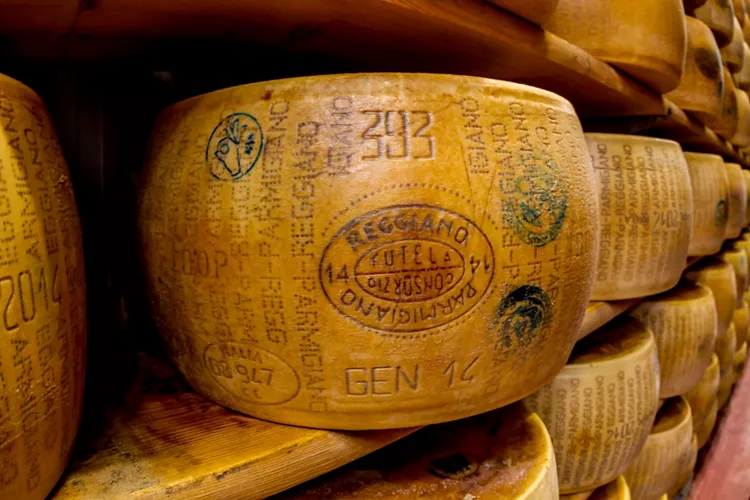
If a wheel does not meet the standards, the Consortium erases the dots. The wheel remains excellent, but cannot be sold as Parmigiano Reggiano. It is a wheel senza di identità (without identity), called mezzano.
We thank the monks, the territory, and the original recipe that on tables across the world we can taste Parmigiano Reggiano!
And this is another piece of the Italian Spirit.