
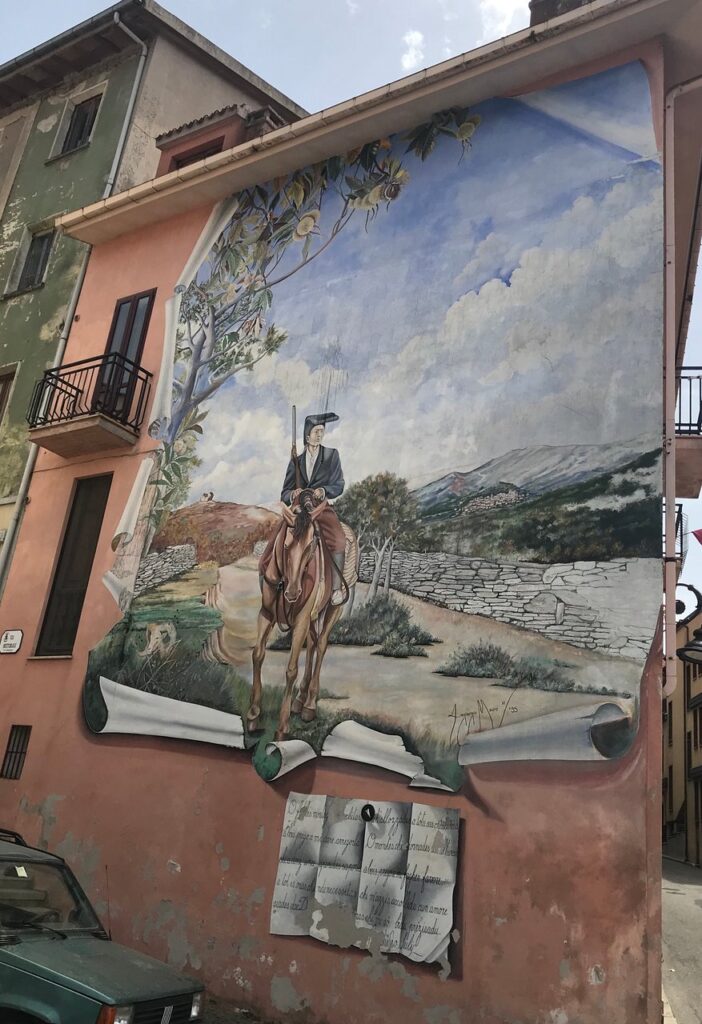
The Orgosolo murals emerged in the late 1960s. A group of students and artists decided to bring art directly to the people. The students were inspired by their teacher, Francesco Del Casino, an art educator who, together with them, painted the first mural in 1969 as a protest against the expropriation of land from shepherds. The murals quickly became a major expression of social discontent. Del Casino became the main driving force behind most of the paintings in the village of Orgosolo; one of his strongest motivations was to involve students in political awareness.
For this reason, the murals depicted themes such as the oppression of Nazism, the struggle for liberation, unemployment, and problems in education. Although many different subjects were introduced over time, political events have remained the dominant theme.
Since then, the walls of the village have never stopped speaking.
More than one hundred and fifty murals, scattered along the streets and houses of the historic center, tell stories of work, freedom, rights, memory, wars, and dreams, as well as local characters and events. Walking through the village feels like stepping inside the pages of a book, where every name or color is represented by a drawing. Some murals are bright and vivid, others have faded with time, but all of them continue to speak: the voice of a people who have made art a tool of identity.
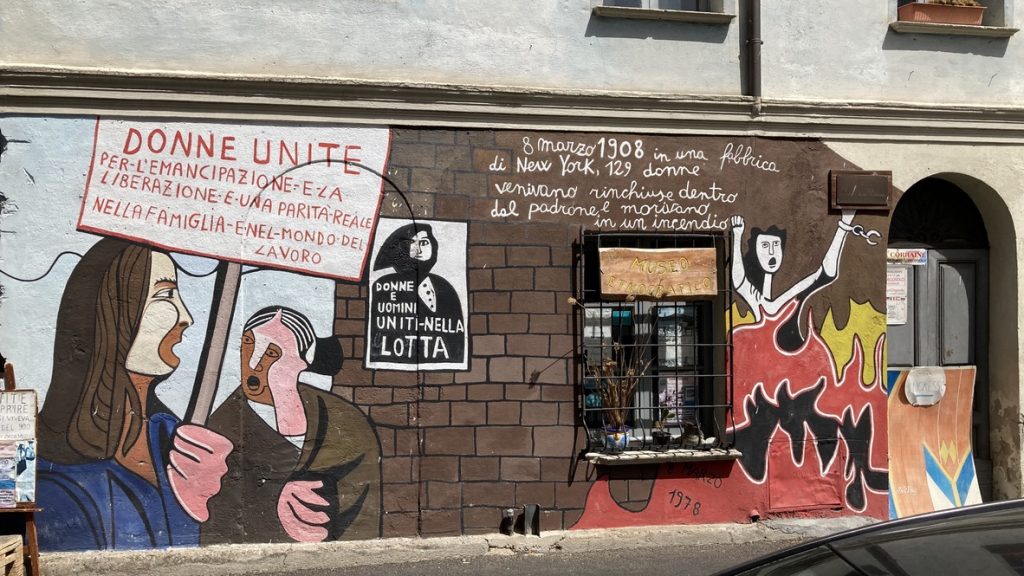
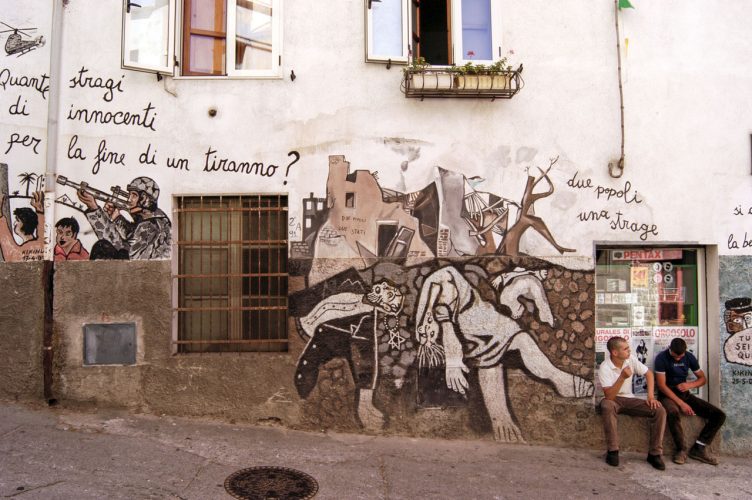
Here we see the union of art and life, a bond that cannot be separated, because murals born as a form of social protest have transformed into a way of preserving memory: each painting celebrates an event, a face, a story. On the walls you can read quotations from poets and thinkers, and see portraits of farmers, women, children, soldiers, shepherds. Some images denounce injustice; others speak of peace and brotherhood among peoples — such as references to the Tiananmen Square protests of 1989, the Pratobello protest, the demonstrations against the G8 in Genoa, or the destruction of the twin towers of the World Trade Center in New York City on September 11, 2021.
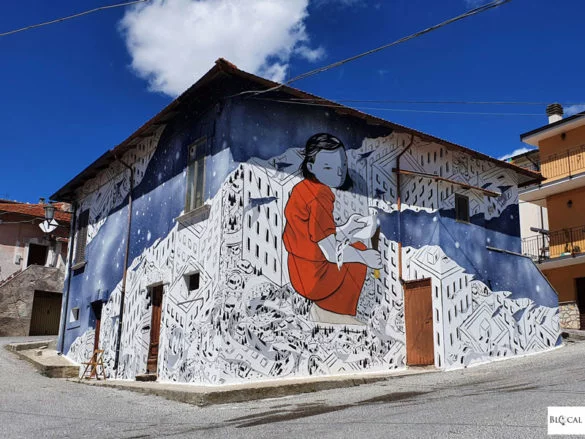
Walking through the village is like moving through a gallery of popular art: the streets become pages, the walls become posters of civic consciousness. The street itself is the protagonist — the element that has made Orgosolo famous throughout the world.
Orgosolo is no longer the “village of bandits,” but the village of art. Today, new murals continue to be painted, often to commemorate contemporary events: wars, migrations, climate change, civil rights. It is like a book, with each chapter telling a story.
Today, the Orgosolo murals are beginning to be recognized as “cultural heritage.” In 2000, the local government allocated millions of lire for their conservation and restoration. As a result, the murals of Sardinia have gained true intellectual recognition.
And this is yet another expression of the Italian spirit: a place far from tourist maps — and beautiful!
Please contact me for Free 20-minute Italian Consultation
6 replies on “The murals of Orgosolo, in the heart of the Barbagia region of Nuoro, Italy”
Looooove it
Beautiful story, would love to see them!
Thanks
Thank you, a trip to Sardinia is definitely worth it!
Thank you for bringing this to our attention. What a marvelous way to restore a city!
True! There are so many stories in Italy!
True! Thank you for the comment :)))