
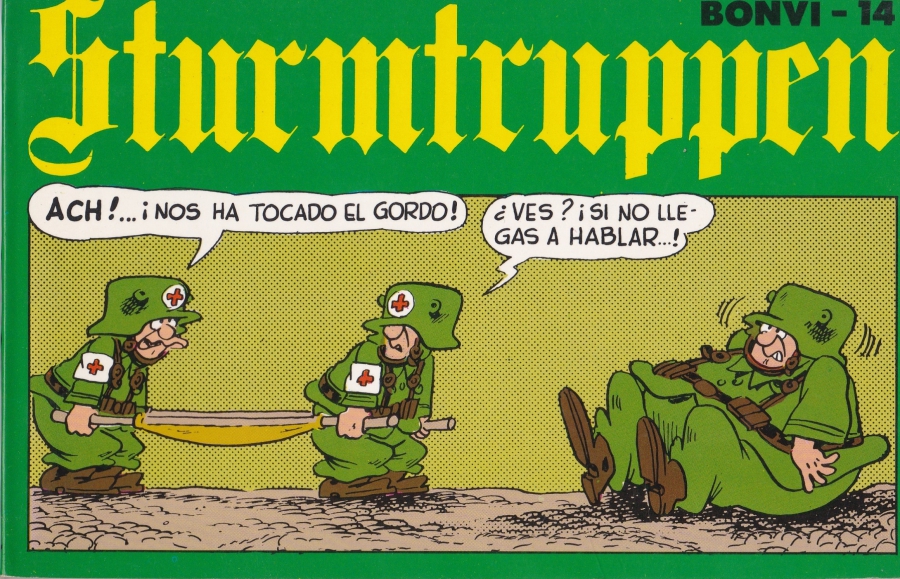
Today we’re talking about a somewhat different cartoon: it makes you laugh and, as always, there is time for reflection within the laughter. These cartoons were part of my adolescence and remain timely, sadly because war remains current.
Sturmtruppen is a famous Italian comic series created by Bonvi (the pen name of Franco Bonvicini, born in Modena on March 31, 1941, and died in Bologna on December 10, 1995).
The stories depict a caricatured army that evokes the German forces of World War II, yet the series is not really about war.
It addresses how absurd orders send young soldiers to die: “Who dies for the homeland has lived much” and the exchange “’Who dies of pneumonia?’ the soldier asks. The commander answers: ‘This is an attack on our most sacred institution.’ It satirizes bureaucracy, blind obedience, and the follies of military life.
It is a sharp, intelligent, often surreal satire that has won generations of readers. The Sturmtruppen are simple, clumsy, tired soldiers, frequently the victims of senseless orders. They speak in a deliberately distorted language full of ironic Germanisms (kaputt, kameraden, kommandante), which has become a trademark of the series.
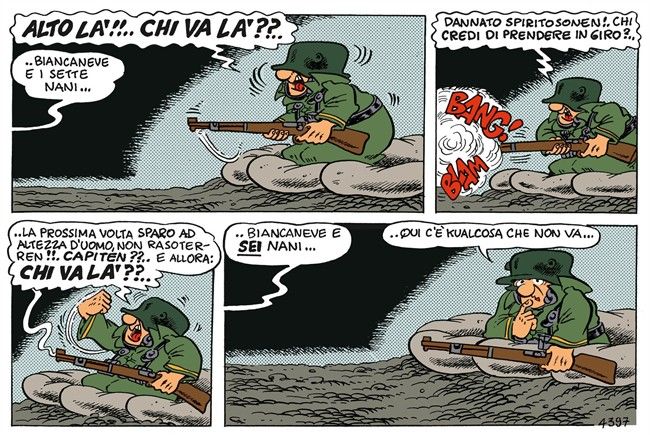
Soldier: Snow White & the seven dwarves.
Guard: Damn joker, who do you think you are fooling?
(shoots gun)
Guard: Next time I will shoot at man height, not low down.
So! Who goes there??
Soldier: Snow White and the SIX dwarves.
Guard: There is something wrong here…
They wear exaggerated uniforms and helmets, use caricatured weapons and vehicles, and the dialogue is comic; situations are repetitive and absurd, as in war: boredom, waiting for the attack — all of this is distorted, satirized, and represented through the ordinary soldiers.
Recurring characters include the Simple Soldier: naive, obedient, often a victim of events, like most soldiers who fight in a war that fundamentally is not theirs. The Sergeant: authoritarian, frustrated, always ready to punish. And of course the Captain — arrogant, incompetent, a symbol of blind power. This brings to mind Kubrick’s film Full Metal Jacket and military drill instructors.
The Doctor — a cynical, detached military physician — recalls some of the absurdity of the frontline TV drama M*A*S*H* (different war, but similar situations and people). The Cook: the camp chef, master of inedible dishes.
Each character represents a human type rather than an individual: the satire is universal, and it’s easy to draw connections to the countless war films and stories told to date, because Sturmtruppen is not a war comic but a comic about the stupidity of war. It exposes the absurdity of rigid military discipline, bureaucracy, the dehumanization of soldiers (like the Vietnam War film Casualties of War), and the repetitiveness and boredom of trench life.
The critique of power and authoritarianism is told with black humor, irony, and a touch of philosophy. In the 1970s and 1980s the property expanded into animated cartoons, television sketches, a dubbed animated series, and a live‑action film (1976). The animated versions preserve the original spirit: distorted language and grotesque comedy.
Sturmtruppen remains relevant and widely read because it shows war from the perspective of the “little people.” It is a classic of Italian satire — a comic that makes you laugh but also makes you think.
One reply on “Sturmtruppen: Italy’s Most Irreverent Military Satire ”
Interessante