
When people are learning a new language, they focus on grammar, vocabulary, and pronunciation. Those are important, but native speakers express themselves in ways that are hard to fit into a simple set of rules but are the key to natural-sounding conversation. They use little conversational fillers, reaction words, and spontaneous expressions that give a language its unique rhythm and flavor: colloquialisms.
A colloquialism is a casual, everyday word or phrase you would use when chatting with friends, but wouldn’t write in a formal letter or an important document. It represents the relaxed way native speakers naturally talk in real life, rather than the strict grammar you read in textbooks.
Here are a few common American English examples:
- Hang out – To spend free time with someone. (“Do you want to hang out after school?”)
- Y’all – Short for “you all,” used when speaking to a group of people. (“Are y’all coming to the game?”)
- Chill – Used to mean relaxed, or to tell someone to calm down. (“Don’t worry about the test, just chill.”)
- What’s up? – A friendly way of asking “How are you?” or “What are you doing?”
Every language and regional dialect has distinct colloquialisms, and mastering them is an important part of sounding natural.
Italian colloquialisms are musical, expressive, and reflect our culture. They appear constantly in conversation, even more than their equivalents do in English.
Eh già — agreement with a touch of resignation. In English you might say, “Yeah, sure” and roll your eyes.

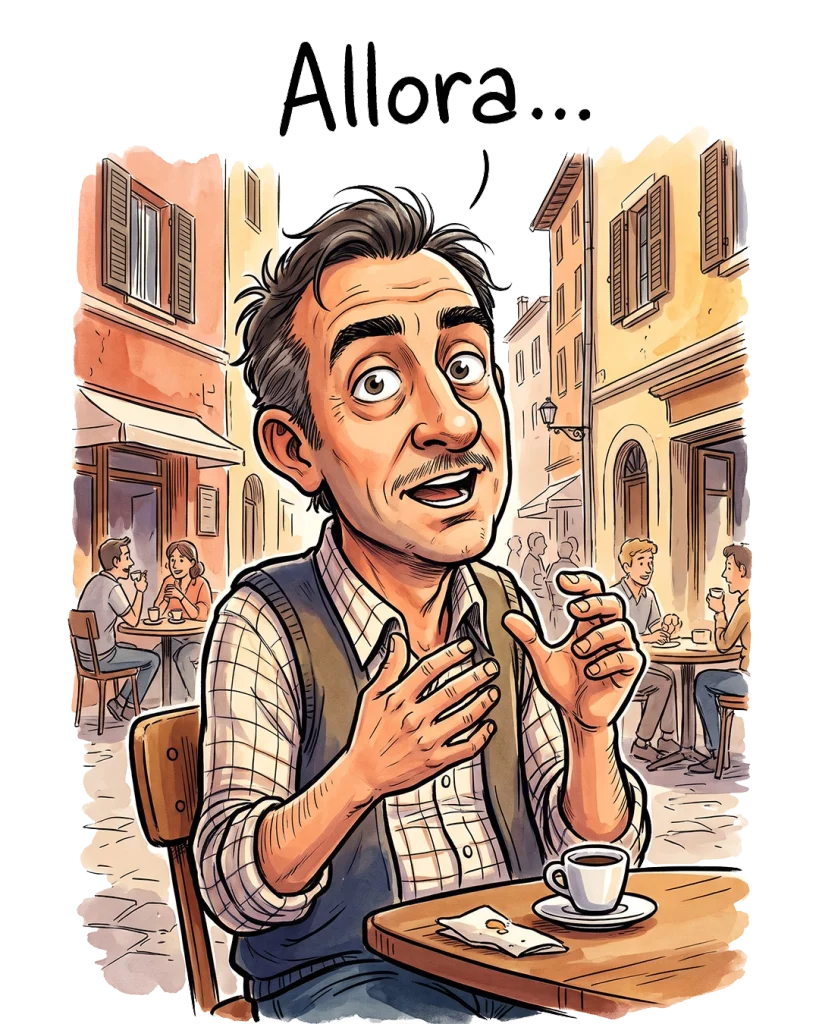
Allora — a starter, a transition, a pause, a reset. English speakers use “Well…” in much the same way.
Boh — total uncertainty. It’s a very short way of saying, “I haven’t a clue.” Use a shrug for emphasis.

Mah — doubt, hesitation, skepticism. Literally means “but.” It’s slightly drawn out, with an implied “…”.

Dai! — encouragement, disbelief, impatience. There is no real English equivalent. The closest might be “Go on,” which can be encouraging or skeptical, depending on tone of voice.

Ecco — pointing something out or confirming it. In English that might be, “there you are” or “there you go.” Like the French “voila.”

Cioè — clarifying, rephrasing, filling space. English speakers use, “I mean…” to introduce a clarification or a rephrasing.

Uffa — frustration or boredom. A very short and expressive way of saying, “Oh, for goodness’ sake!”

Although each language has its own style, colloquialisms serve the same purpose everywhere: They help speakers manage conversation, express feelings, and connect socially. They make speech sound natural. A person can speak perfect grammar and still sound “foreign” if they never use colloquialisms.
Embracing these words, using allora, eh già, boh, mah, dai, and ecco, helps you to sound more authentic, understand real conversations, connect socially, and express feelings without struggling to put together long sentences.
These tiny words are the heartbeat of Italian conversation. You might say that grammar builds sentences but colloquialisms build relationships.
Colloquialisms are universal, and each culture shapes them differently. Learning them means stepping into the real world of any language, where people hesitate, react, complain, agree, doubt, and connect.
If you want to speak like a native, start with the small words. They’re the biggest secret.
Please leave a comment!
2 replies on “Colloquialism…”
This is such a funny yet fantastic article!! It really gives a gist of the Italian colloquialism and popular verbal reactions to everyday life events!!!
Un eccellente blog, Professoressa Lea! We learned that real, everyday Italians use lots of colloquialisms, just as we do in English. When my mother spoke Italian, it was actually a dialect of Southern Italian/New Jersey – and the colloquialisms were different. ALLORA, that’s what makes speech so interessante! A presto, Riccardo